Train at the Cellular Level: The Advantage of Exercise Inside an Infrared Sauna
August 16, 2026
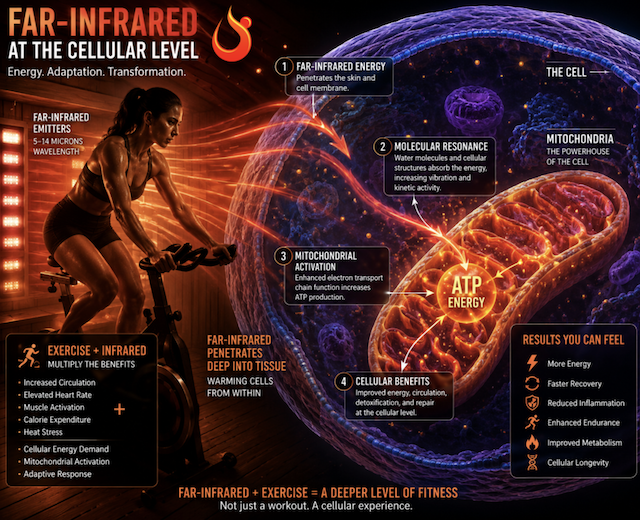
Most people think of exercise in terms of what they can see and feel: muscles contracting, heart rate rising, sweat pouring, calories burning, and strength or endurance improving. But every workout ultimately begins at a much smaller level—the cell. That is where energy is produced, oxygen is utilized, metabolic signals are generated, and adaptation begins. Training inside an infrared sauna creates a unique environment because the body is challenged not only by exercise, but simultaneously by heat and radiant infrared energy. Instead of simply exercising in a warm room, the goal is to combine muscular work, cardiovascular demand, heat stress, and absorption of infrared radiation into one integrated training experience.
Far-infrared radiation, or FIR, is part of the electromagnetic spectrum beyond visible light. Unlike heating a room primarily by warming the surrounding air, infrared energy is radiant energy that can be absorbed at the body's surface and converted to heat within tissue if the client is close enough to the FIR heating source (1-3 ft.). Scientific reviews have described interactions between FIR and biological tissue involving water molecules, cell membranes, mitochondrial metabolism, circulation, and cellular signaling, although the precise mechanisms remain areas of active research. This distinction is important: infrared is not simply another word for heat. Heat is an effect; infrared is electromagnetic radiation capable of transferring energy to tissue.
Inside the cell is where exercising inside an infrared sauna becomes particularly interesting. Exercise already places enormous demands on cellular energy production. Working muscle requires a continuous supply of ATP—adenosine triphosphate, the molecule cells use as their immediate energy currency. Mitochondria respond by accelerating oxidative metabolism to help meet that demand. At the same time, heat exposure creates an additional physiological stressor, increasing thermoregulatory demands and challenging the body's ability to maintain internal stability. Research on controlled heat exposure shows that repeated heat stress can stimulate cellular adaptive responses, including increases in intracellular heat-shock proteins such as HSP70. These proteins participate in maintaining protein integrity and cellular resilience under stress.
Think of this as cellular conditioning. During conventional exercise, cells are asked to respond to mechanical and metabolic stress. During exercise performed in an infrared-heated environment, those demands occur alongside thermal stress and radiant energy exposure. The body must exercise, regulate temperature, circulate blood, dissipate heat, and maintain cellular function simultaneously. Rather than eliminating stress, the objective of training is to apply an appropriate dose of stress so that the body adapts. Heat becomes another training variable.
And, infrared radiation adds another dimension to this environment. Laboratory and review literature has explored FIR-related changes in mitochondrial activity, membrane behavior, reactive oxygen species signaling, nitric-oxide-related pathways, circulation, and cellular metabolism. A recent review of infrared therapies describes evidence suggesting FIR can influence mitochondrial respiratory activity and ATP-related metabolism, while also emphasizing that infrared's biological effects depend heavily on wavelength, dose, irradiance, and exposure conditions.
The mitochondrial connection is especially relevant to fitness because mitochondria are fundamental to endurance, recovery, metabolic health, and the ability to sustain repeated muscular contractions. Exercise itself is one of the most powerful stimuli for improving mitochondrial capacity. When infrared exposure and heat stress are layered onto exercise, the concept is not that infrared replaces the workout—it is that the workout provides the metabolic demand while the environment provides additional physiological stimuli. The exercise tells the cell, “produce energy and adapt,” while heat and infrared exposure create additional signals to which the body must respond.
There is also a vascular component. As body temperature rises, blood vessels in the skin dilate and circulation is redirected toward the body's surface to assist with cooling. Exercise simultaneously requires increased blood flow to active muscle. This creates a substantial circulatory challenge. Evidence from heat-therapy research indicates that repeated passive heating can improve certain measures of vascular function and blood pressure, although results vary by protocol and population. During infrared exercise, this vascular stimulus occurs while the muscles themselves are actively demanding oxygen and nutrients.
Sweating is another obvious benefit of the experience, but it should not overshadow what is happening beneath the sweat. Perspiration is primarily the body's cooling mechanism, and the liver and kidneys remain the body's major detoxification organs, but IR sweating generates detox at much higher percentages than sweat induced from traditional convection saunas.
The more compelling biological story is the combination of muscular contraction, increased circulation, elevated temperature, cellular energy demand, and adaptive stress signaling. The sweat is what you see. The cellular response is what you don't see.
Proximity to the infrared source also matters. Radiant energy follows physical principles that are different from simply maintaining a warm ambient room. An individual exercising close enough to an infrared emitter can receive substantially more radiant exposure than someone positioned much farther away. That is why an infrared workout environment should be designed around effective delivery of radiant energy rather than merely achieving a high room temperature. A large heated room may feel hot, but it should not automatically be considered biologically equivalent to that of training inside of a well designed FIR sauna.
This creates a powerful way to think about infrared exercise: train the body from the cell outward. Muscle strength, cardiovascular fitness, mobility, body composition, and athletic performance are the visible outcomes of countless cellular adaptations occurring beneath the surface. Mitochondria produce energy. Blood vessels deliver oxygen and nutrients. Heat-shock proteins participate in cellular protection. Metabolic pathways respond to changing energy requirements. Every rep, every posture, and every interval ultimately sends signals down to the cellular level.
The real advantage of training inside an infrared sauna, therefore, is not simply that the workout feels hotter or produces more sweat. It is the opportunity to combine multiple physiological stimuli at the same time: exercise stress, thermal stress, cardiovascular demand, and infrared radiant exposure. Exercise is already a cellular event, and adding a carefully controlled infrared and heat environment creates a distinctive training stimulus.
Traditional exercise asks the body to move. Heat training asks the body to adapt to temperature. Infrared exposes tissue to radiant energy. Combine those elements intelligently, like that of the HOTWORX 3D Training Method, and the workout becomes more than movement performed in a hot room. It becomes an environment designed to challenge the body on multiple physiological levels at once, from muscles and circulation all the way down to cellular stress responses and energy metabolism.
👊🔥
SHARE THIS POST

Stephen P. Smith, MA
CEO and Creator of HOTWORX, Author, Former National Collegiate Bodybuilding Champion and Arena Football Player, Certified Professional Trainer
GET THE LATEST HOTWORX BLOGS SENT RIGHT TO YOUR INBOX!
Sign up to receive weekly emails:
Thank you!